
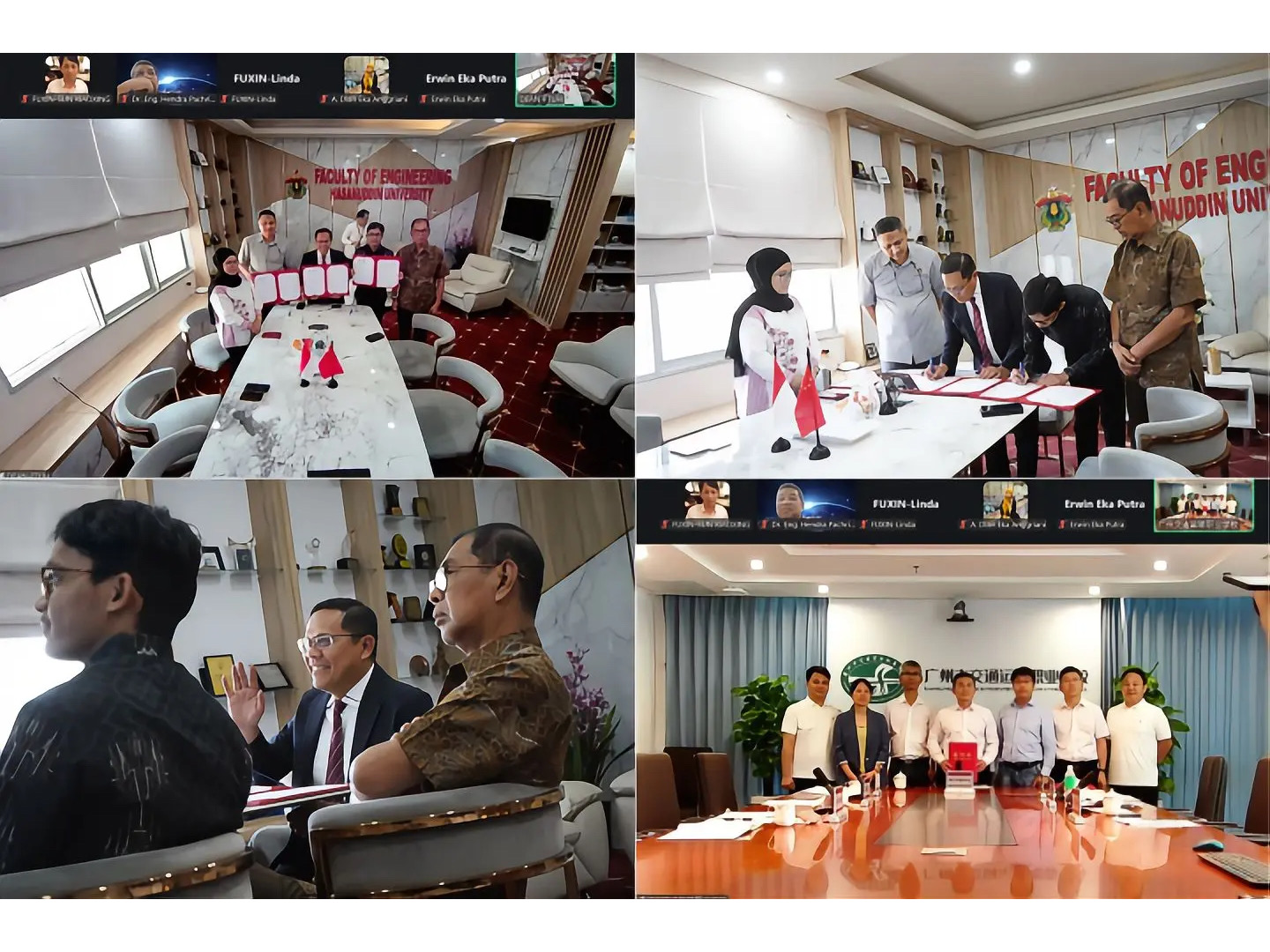
Gowa, August 5, 2026 – The Faculty of Engineering, Hasanuddin University (FT Unhas) has once again strengthened its international education network through the signing of a Tripartite Cooperation Agreement with Guangzhou Traffic and Transportation Vocational School and Anhui Fuxin Education Consulting Co., Ltd., China. The agreement was signed virtually via Zoom Meeting on Wednesday, August 5, 2026.
This collaboration marks a strategic step in developing an integrated international education system linking middle-level vocational education in China with undergraduate education at the Faculty of Engineering, Hasanuddin University. Through this partnership, the three parties are committed to establishing a cross-border educational pathway focused not only on academic achievement, but also on strengthening global competencies, cross-cultural skills, and graduate readiness for the demands of the international workforce.
Academic Scheme Innovation: “3+1+3” and Industry Involvement
One of the main programs to be developed is the integrated “3+1+3” education pathway. In this scheme, participants first undergo 3 years of vocational education at Guangzhou Traffic and Transportation Vocational School, China. The next stage is a 1-year international matriculation program, including six months of English and Indonesian language preparation and six months of academic strengthening through bridging courses, both facilitated by Anhui Fuxin Education Consulting Co., Ltd.
Upon completion of these stages, students will continue with 3 years of undergraduate education at FT-UH. This program is designed through a joint credit recognition mechanism and curriculum alignment to ensure a structured transition from vocational to undergraduate education. In its initial phase, the program is prioritized for strategic study programs, including Transportation Engineering, Mechanical Engineering, and Electrical Engineering.
Besides expanding access for international students to study in Indonesia, the program is expected to enrich the academic atmosphere at FT Unhas through cross-cultural interactions and knowledge exchange. The presence of international students is also a key component in strengthening the internationalization of learning, increasing the global exposure of the academic community, and expanding students’ academic and professional networks.
This partnership also involves Chinese companies operating in Indonesia in curriculum alignment, implementation of practical training, provision of internship opportunities, and expanding employment access for graduates. Industry involvement from the learning planning stage is expected to strengthen the link between graduate competencies and labor market needs, particularly in the transportation, technology, and engineering-based industry sectors.
Commitment of the Parties
The signing ceremony was attended by the leaders of the Faculty of Engineering, Hasanuddin University. The Dean of FT Unhas, Prof. Dr.Eng. Ir. Muhammad Isran Ramli, S.T., M.T., IPM., AER., led the event, accompanied by the Vice Dean for Partnerships, Research, Innovation, and Alumni, Prof. Muhammad Bachtiar Nappu, S.T., M.T., Ph.D. Also present online were the Vice Dean for Academic Affairs and Student Affairs, Dr.Eng. Hendra Pachri, S.T., M.Eng., and the Global Engagement Office (GEO) FT Unhas team.
In his remarks, the Dean of FT Unhas, Prof. Isran Ramli, emphasized that this tripartite cooperation marks an important initial step in realizing the implementation of Tridarma Perguruan Tinggi at an international level.
“This tripartite collaboration is a very significant starting point in concretely implementing Tridarma Perguruan Tinggi at the international level. We hope this partnership yields practical programs that are clear, measurable, and sustainable,” said Prof. Isran Ramli.
He added that mutual trust and shared benefit serve as the main foundation for building long-term partnerships.
“Based on trust and the principle of mutual benefit, our main focus is on strengthening the quality of human resources. We hope that this cooperation does not end at the signing of documents, but will be realized through academic activities, research, student and faculty exchanges, as well as collaborations with industry,” he explained.
Prof. Isran also expressed his appreciation to all parties who contributed to forming this partnership.
“I would like to express my highest appreciation to all parties who worked to make this collaboration a reality. May this partnership be successful and have a long-lasting impact on all involved institutions,” he added.
Additionally, Principal of Guangzhou Traffic and Transportation Vocational School, Wu Xinghong, conveyed his respect and enthusiasm for the partnership with FT Unhas. He considers the Faculty of Engineering, Hasanuddin University a strategic partner with a strong reputation in education in Indonesia, especially in Eastern Indonesia.
“The Faculty of Engineering, Hasanuddin University is a highly strategic partner for us. FT Unhas is well-recognized as one of Indonesia’s leading higher education institutions and is among the best education centers in Eastern Indonesia,” stated Wu Xinghong.
He explained that his institution has been established since 1964 and has industrial training facilities with an investment value of 20 million USD. The institution also trains over 20,000 skilled workers each year.
“Our school has long experience in developing vocational education and industrial training. Through this collaboration, we are optimistic that we can combine the strengths of vocational and undergraduate education to produce even more competitive graduates,” he said.
Wu Xinghong also emphasized the importance of educational institutions’ readiness in responding to advancements in artificial intelligence and global industrial transformation.
“The development of Artificial Intelligence (AI) has brought major changes to the transportation and industrial sectors. Therefore, educational institutions need to cooperate in preparing graduates who not only have technical skills but can also adapt to technological developments and the needs of the global job market,” he explained.
Meanwhile, Chairman of Anhui Fuxin Education Consulting Co., Ltd., Sun Xiaoxing, remarked that the “3+1+3” integration program has the potential to be a benchmark in the development of cross-border education.
“Guangzhou Traffic and Transportation Vocational School is one of China’s top national vocational schools, having won the National Teaching Achievement First Prize. Through the ‘3+1+3’ model, we are striving to build an integrated cross-border learning system,” said Sun Xiaoxing.
He added that his party is committed to supporting the implementation of an intensive bilingual matriculation program so that students are well-prepared before entering the academic environment in Indonesia and become industry-ready professionals.
“We are ready to oversee the intensive bilingual matriculation program. We believe this cooperation will not only produce bachelor’s degree graduates, but also experts with international qualifications ready to be absorbed by major industries—whether in Indonesia, China, or elsewhere,” he explained.
Impact on the Industrial Sector and the Future of Collaboration
The scope of cooperation is not limited to the acceptance and exchange of students. The “Tripartite Cooperation Agreement” also opens opportunities for faculty exchanges, joint research, collaborative scientific publications, and innovation development in the fields of transportation engineering, smart manufacturing, and vocational education. In addition, the three parties have the potential to organize winter/summer camp programs and bilingual cultural promotion. The development of these programs is expected to have a direct impact on increasing international mobility of students and faculty, strengthening the quality of learning, expanding research collaborations, and boosting industry engagement in the educational process.
Through this partnership, the Faculty of Engineering at Hasanuddin University affirms its firm commitment to delivering world-class educational innovation, strengthening academic reputation, and making a meaningful contribution to the development of national and global industries.