
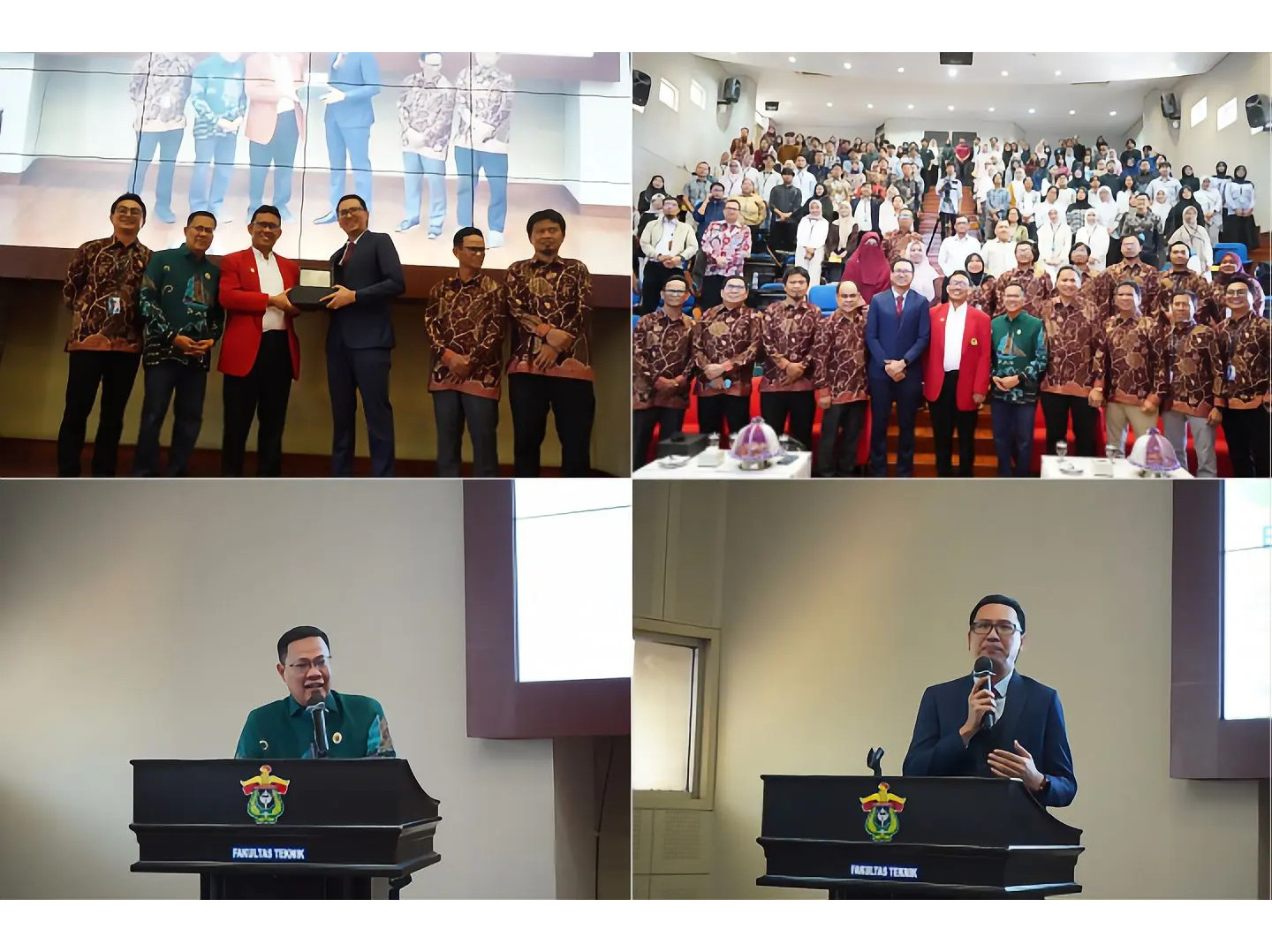
The Faculty of Engineering at Hasanuddin University (FT Unhas) continues to strengthen its transformation as a world-class center of excellence in science and technology by holding the International Conference on Research, Engineering, Science and Technology (IC-REST 2026) on Wednesday, September 2, 2026, at the Unhas Engineering Campus, Gowa. Bearing the theme “Navigating Tomorrow: Integrating AI and Advanced Materials for Sustainable Maritime and Human Development,” this international conference discussed the integration of Artificial Intelligence (AI), advanced materials, and the utilization of renewable maritime energy as solutions to the climate crisis and energy transition.
Organizing Committee Report: Global Enthusiasm and Rigorous Selection
The Chair of IC-REST 2026, Andi Lolo Sinrang Arisaputra, S.T., M.Eng., Ph.D., in his opening report expressed deep appreciation for the enthusiastic response of the global scientific community to this year’s conference. He reported that the committee received 105 paper submissions from various institutions and countries.
Through verification processes, adjustment of editorial notes, and strict re-registration, 86 participants were officially registered and presented their research findings. Dr. Andi Lolo expressed his gratitude to all authors, researchers, reviewers, keynote speakers, and the entire committee who worked hard to make IC-REST 2026 an inclusive and inspiring platform for academic and professional collaboration.
This international conference was officially opened by the Chair of LPPMP, Prof. dr. Muh. Nasrum Massi, Ph.D., Sp.MK. In his welcome speech, the faculty leadership emphasized the importance of steering technological development not only toward computational sophistication, but also grounded in ethics, sustainability, and Indonesia's maritime potential.
This series of scientific forums presented a lineup of experts and international keynote speakers who brought research in materials, AI, and energy from laboratory domains to real-world applications.
Innovation in Indonesia’s Offshore Wind Energy
Internal keynote speaker from FT Unhas, Dr.Eng. Ir. Faisal Mahmuddin, S.T., M.Inf.Tech., M.Eng., IPM. (Head of the Department of Naval Architecture & Head of Pustekno-COT Unhas), presented strategic research entitled “Wind Energy Potential Assessment Using MFS-BEM Approach in Indonesia's Offshore Waters”. Dr. Faisal revealed that eastern Indonesian waters, especially in the Maluku Sea, Banda Sea, and Arafura Sea, have exceptionally high offshore wind energy potential, with an average power density reaching 4.17 (categorized as Good to High Potential) and average wind speed reliability of 6.82 m/s based on 10 years of QuikSCAT satellite data.
/9-1.jpg)
In his presentation, Dr. Faisal explained the use of the Blade Element Momentum (BEM) method, validated using QBlade simulations, as well as uncertainty analysis via Monte Carlo Simulation. The study results showed an expected capacity factor of 32.77% for offshore wind turbines. As a solution for deep waters (50 meters), he introduced the Mobile Floating Structure (MFS) concept with a Semi-Submersible configuration, which is flexible, stable, and movable according to shifting high-wind locations, supporting the Net Zero Emission 2060 target.
Water Filtration Innovation and Environmental AI
From an environmental technology perspective, Dr. Eng. Joanna Fronczyk from the Warsaw University of Life Sciences (SGGW), Poland, presented research titled “Beyond the Beaker: Navigating the Real-World Limits of Stormwater Filtration Media”. Dr. Fronczyk criticized the limitations of static laboratory testing in addressing urban stormwater runoff loaded with heavy metal pollutants and microplastics. Through low-cost natural mineral–based filter media architectures (such as zeolite and limestone sand), her research demonstrated that these media are highly robust in retaining heavy metals by more than 90 percent in field conditions.
Meanwhile, Prof. Ir. Ts. Dr. Mohd Fadhil Bin Md Din from Universiti Teknologi Malaysia (UTM) introduced the concept of Environmental Intelligence through the topic “AI-Enabled Environmental Intelligence for Planetary Resilience”. Utilizing AI-based IoT sensor networks, this system transforms passive environmental monitoring into a proactive cycle of Sense, Predict, and Prevent, increasing the accuracy of water pollution detection up to 95.1% and reducing water contamination incidents by 44.2%.
Future Advanced Materials Engineering
In the field of physics and advanced materials, Dr. Shibghatullah Muhammady, Research Scientist from the Solid State Chemistry Laboratory at RIKEN, Japan, presented a first-principles computational study of barium titanium oxyhydrides. This research successfully unraveled the thermodynamic stability mechanics and ion diffusion kinetics in oxyhydride materials, which hold great potential as ionic conductors and efficient catalysts for environmentally friendly ammonia synthesis.
/9-2.jpg)
The Dean of the Faculty of Engineering Unhas, in his opening remarks, delivered a profound message about the essence of technological progress for human civilization.
“Science tells us what is possible, and engineering helps us to build it. Yet wisdom, ethics, and human values are what guide us in deciding what ought to be built. Let us navigate the future together with knowledge as our compass, innovation as our driver, and humanity as our ultimate goal,” affirmed the Dean of FT Unhas.
The organization of IC-REST 2026 reaffirms FT Unhas’s ongoing commitment to producing internationally standardized research with direct impact for society and industry. The event concluded with an agreement to strengthen international research networks, joint research collaborations, and the formulation of science-based policy recommendations to support sustainable development in maritime regions.