
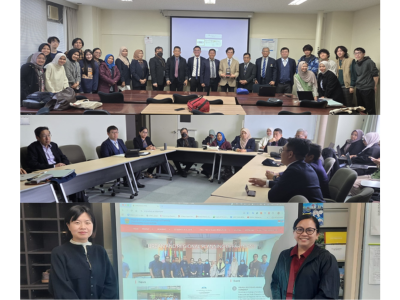
Universitas Hasanuddin conducted an academic visit to Toyohashi University of Technology (TUT), Japan, from 9 to 14 November 2025 as part of the International Partnership Networking Enhancement Program (P2MJKI) 2025. The visit focused on aligning the implementation of the MoA Twinning Program between UNHAS and TUT while also exploring opportunities for student internship collaboration.
This activity represents a strategic effort to institutionalize international academic cooperation, particularly within the Master’s Program in Urban and Regional Planning (MPWK) and Master’s Program in Architecture, following the extension of the UNHAS–TUT MoA in 2025. Rather than a ceremonial engagement, the visit emphasized technical synchronization, student monitoring, and academic quality assurance to strengthen measurable outcomes such as joint research, publications, and global academic reputation.
.png)
During the visit, the UNHAS delegation held intensive discussions with Prof. Junichiro Asano, Head of the Urban Planning Laboratory, Department of Architecture and Urban Systems, TUT. Key agendas included joint supervision mechanisms, credit recognition and conversion, governance of the twinning scheme, and the long-term sustainability of the program. The delegation also explored collaboration frameworks for future student and staff mobility.
Academic collaboration was further strengthened through discussions on joint research and international publications, attended by Prof. Takanobu Inoue, Dean of the Department of Architecture and Civil Engineering at TUT. Opportunities for collaboration under thematic research groups were presented as potential platforms for sustained research partnerships.
As part of academic evaluation, students participating in the Twinning Program presented their thesis progress, while a doctoral student from UNHAS delivered a dissertation presentation. These sessions enabled constructive feedback from faculty members of both institutions, reinforcing academic rigor and research direction. In addition, courtesy visits to TUT leadership and dialogue sessions with UNHAS students provided insights into academic adaptation and student support mechanisms in Japan.
The visit also included focused discussions on the continuation of the Internship Program, highlighting the commitment of both institutions to expand practical learning opportunities for undergraduate students. Overall, this engagement underscores Universitas Hasanuddin’s commitment to deepening international academic partnerships, enhancing student learning experiences, and strengthening the operational foundation of its global programs through P2MJKI.