
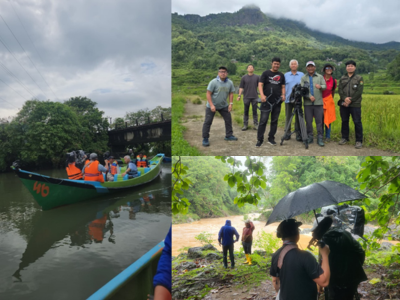
The Geological Engineering Study Program, Faculty of Engineering, Hasanuddin University, in collaboration with NHK Japan, successfully conducted an international geological inventory from January 7 to 23, 2026, across South Sulawesi, Southeast Sulawesi, and North Sulawesi. This initiative aimed to deepen understanding of Sulawesi Island’s geological significance while also producing a collaborative documentary film on Sulawesi’s geology.
The collaboration involved the Vice Rector for Partnerships, Innovation, Entrepreneurship, and Business of Hasanuddin University, alongside the Geological Engineering Study Program and NHK Japan. The activity brought together leading researchers from Hasanuddin University, including Prof. Dr. Eng. Adi Maulana, Dr. Sc. Muhammad Sulhuzair Burhanuddin, and Dr. Sc. Wildan Nur Hamzah, as well as Yutaro Mimuro from NHK Japan.
Field investigations were conducted across several key locations in South Sulawesi, Southeast Sulawesi, and North Sulawesi, representing a wide range of geological environments, including karst landscapes, river systems, hilly terrains, and rural areas. The team carried out systematic direct observations, comprehensive data collection, and professional documentation through photographs and video recordings to support both scientific analysis and the production of a geological documentary.
Sulawesi was chosen as the subject of this documentary for several important reasons. First, the island is characterized by highly complex geological features formed by the interaction of multiple tectonic plates. Second, it hosts diverse and unique landscapes, including extensive karst systems, ancient rock formations, and active geological processes. Third, Sulawesi presents a strong connection between geological conditions and human life, where communities adapt closely to their natural environment. Finally, the island remains relatively underrepresented in global scientific documentaries, making it a compelling subject for international exposure and educational storytelling.
In addition to research activities, this collaboration is set to produce a documentary film highlighting the geological uniqueness of Sulawesi. The documentary, jointly developed by Hasanuddin University and NHK Japan, is expected to showcase field exploration, scientific insights, and the dynamic natural processes shaping the island.
Despite facing dynamic weather conditions, including rainfall in several locations, the team successfully completed all planned activities. These conditions provided valuable insights into real-time geological processes and environmental dynamics. Access to remote sites was supported by both land and water transportation, ensuring comprehensive field coverage.
Beyond data collection, the collaboration also served as a platform for knowledge exchange and interdisciplinary interaction between Hasanuddin University and NHK Japan. Through joint fieldwork and discussions, the teams gained a more integrated understanding of Sulawesi’s complex geological framework.
This initiative highlights the commitment of Hasanuddin University in advancing earth science research and expanding international collaboration. The results of this geological inventory, along with the forthcoming documentary, are expected to contribute to future research, enhance geological mapping, and broaden public understanding of geology in the Sulawesi region.