
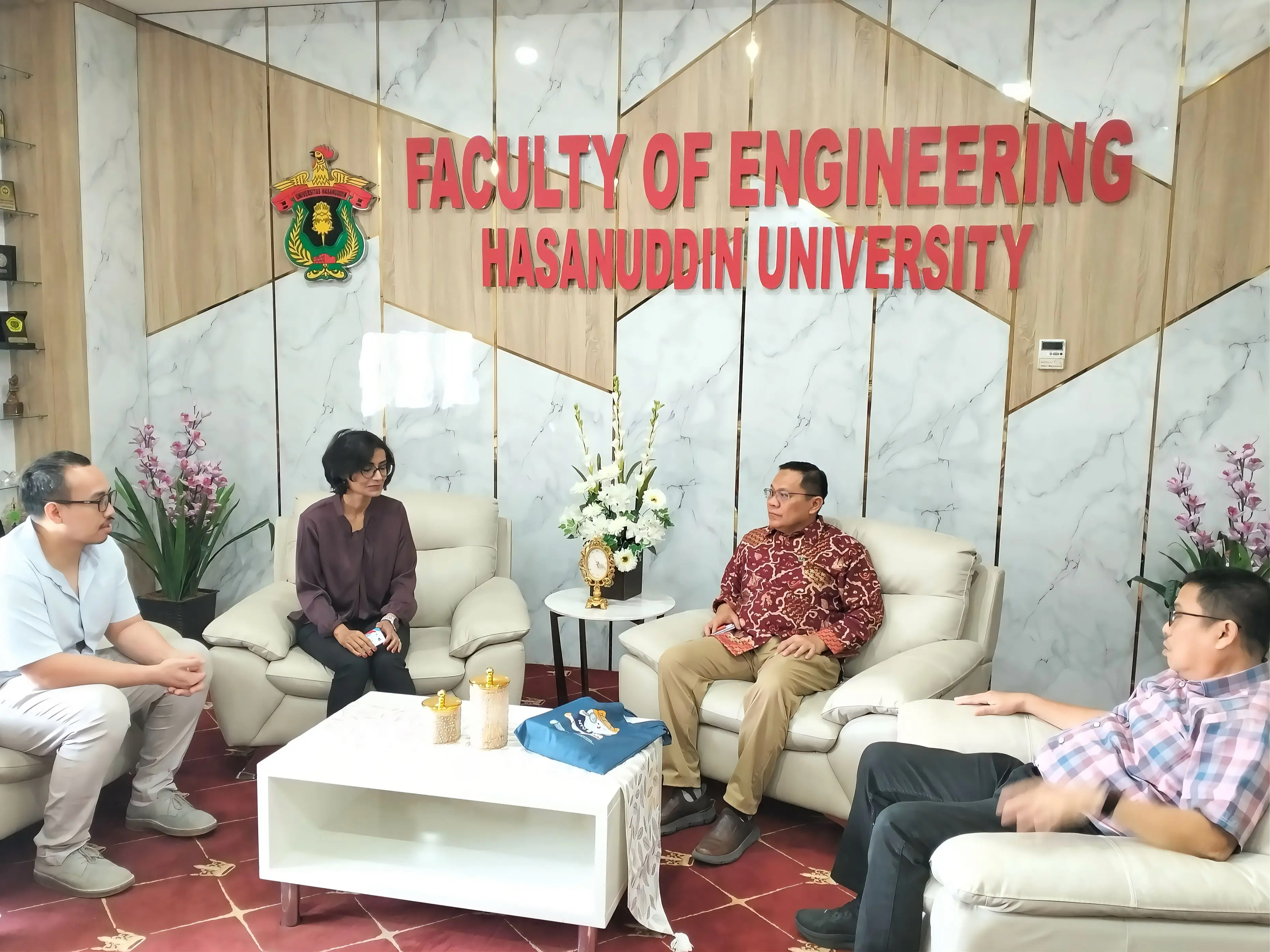
Gowa, October 1st, 2026 – The Faculty of Engineering, Universitas Hasanuddin (FT Unhas), strengthened its international academic network through a series of collaborative activities with Nanyang Technological University (NTU) Singapore during the first semester of the 2026/2027 Academic Year. The collaboration was implemented through the NTU–UNHAS Collaborative Multidisciplinary Course on Environmental Challenges, Energy Transition & Sustainability, complemented by a Cultural Exchange program that provides opportunities for learning and cross-cultural interaction among students from both institutions.
As part of this collaboration, the Guest Lecture of the NTU–UNHAS Collaborative Multidisciplinary Course was held on Tuesday, September 29, 2026, at the Exhibition Hall, Center of Technology (CoT) Building, Faculty of Engineering, Universitas Hasanuddin. The activity was designed to broaden students’ learning experiences through a multidisciplinary approach, particularly in understanding environmental challenges, energy transition, and sustainability.
The program began with participant registration and an opening session, including remarks by the Dean of the Faculty of Engineering, Universitas Hasanuddin, Prof. Dr. Eng. Ir. Muhammad Isran Ramli, S.T., M.T., IPM., AER. Following the opening session, the program continued with a Guest Lecture & Simulation Game and a project consultation session with the guest speaker and teaching team.
During the Guest Lecture & Simulation Game, Dr. Swati Sharma served as the guest speaker and also participated in the Project Consultation Session alongside the teaching team. These sessions provided students with opportunities to gain knowledge, engage in simulation-based learning, and further develop their projects through direct consultation.
Through the combination of the guest lecture, simulation game, and project consultation session, students not only gained academic perspectives within an international learning environment but also actively participated in the learning process. Students were able to deepen their understanding through simulation while discussing their ideas and projects directly with the guest speaker and teaching team.
The multidisciplinary approach adopted in the program is particularly important because environmental challenges and energy transition extend beyond a single field of study. Addressing sustainability requires connections among engineering knowledge, resource management, technological innovation, policy, and an understanding of social and environmental impacts. Through the theme Environmental Challenges, Energy Transition & Sustainability, students were encouraged to explore these interconnected issues from a broader perspective.
/15-1.jpg)
The learning experience continued with field visits on Wednesday, September 30, 2026. Accompanied by the program team, participants visited the Revitalising Informal Settlements and their Environments (RISE) program site and Rappo Indonesia in the Untia area of Makassar. The visits provided participants with opportunities to observe firsthand different approaches to addressing environmental and sustainability challenges at the community level.
The first visit took place at the RISE program site in Kampung Bonelengga/Bulurokeng, Untia. RISE is an international research program and green infrastructure initiative focused on improving the environmental conditions of informal settlements, particularly through improvements in water, sanitation, and community health. At the site, participants received an overview of the RISE program and visited a domestic wastewater treatment facility that had been developed as part of the program’s implementation in the research area.
The field activities then continued with a visit to Rappo Indonesia in Untia. Rappo Indonesia is a social enterprise that transforms plastic waste into a range of lifestyle and corporate products while engaging and empowering women from coastal communities in Untia. During the visit, participants toured the production site and observed firsthand how plastic waste is processed into products with practical and economic value.
The visits to RISE and Rappo Indonesia offered two different perspectives on the implementation of sustainability principles at the local level. Through RISE, participants were able to observe how environmental infrastructure and management can support improvements in sanitation and community health. Meanwhile, Rappo Indonesia demonstrated how plastic waste management can be integrated with social entrepreneurship and community empowerment.
These field experiences complemented the learning activities previously conducted through the guest lecture, simulation game, and project consultation session. By observing real-world conditions and practices, participants had the opportunity to connect academic discussions on environmental challenges, resource management, and sustainability with their practical implementation in local contexts.
/15-2.jpg)
In addition to the academic activities and field visits, the collaboration between FT Unhas and NTU Singapore also includes a Cultural Exchange program. The activity is part of NTU’s visit to Makassar from September 28 to October 2, 2026. The Faculty of Engineering, Universitas Hasanuddin, will host the Cultural Exchange on October 1, 2026, bringing together Universitas Hasanuddin students and participants from NTU.
Through the Cultural Exchange, students from Universitas Hasanuddin and NTU will have opportunities to interact and learn about each other’s cultures. In addition to introducing participants to the academic environment at FT Unhas, the program will provide opportunities for NTU participants to learn more about student activities and local culture.
These cross-cultural interactions will complement the academic and field-based experiences gained by students throughout the program. Bringing together students from different backgrounds is expected to broaden their perspectives on learning, collaboration, and communication within an international academic environment.
For the Faculty of Engineering, Universitas Hasanuddin, the collaboration with NTU Singapore forms part of its efforts to strengthen an academic environment that connects learning, innovation, international networks, and real-world challenges. The experience of participating in multidisciplinary learning, field visits, and international interactions is expected to enrich students’ competencies while encouraging the development of ideas and projects relevant to the sustainability agenda.
Through the integration of the multidisciplinary course, project development, field visits, and cultural exchange, the FT Unhas–NTU Singapore collaboration is expected to continue growing in the years ahead. This collaboration also reflects the Faculty of Engineering, Universitas Hasanuddin’s commitment to building an educational ecosystem that is open to global knowledge, innovation, and cross-institutional collaboration.