
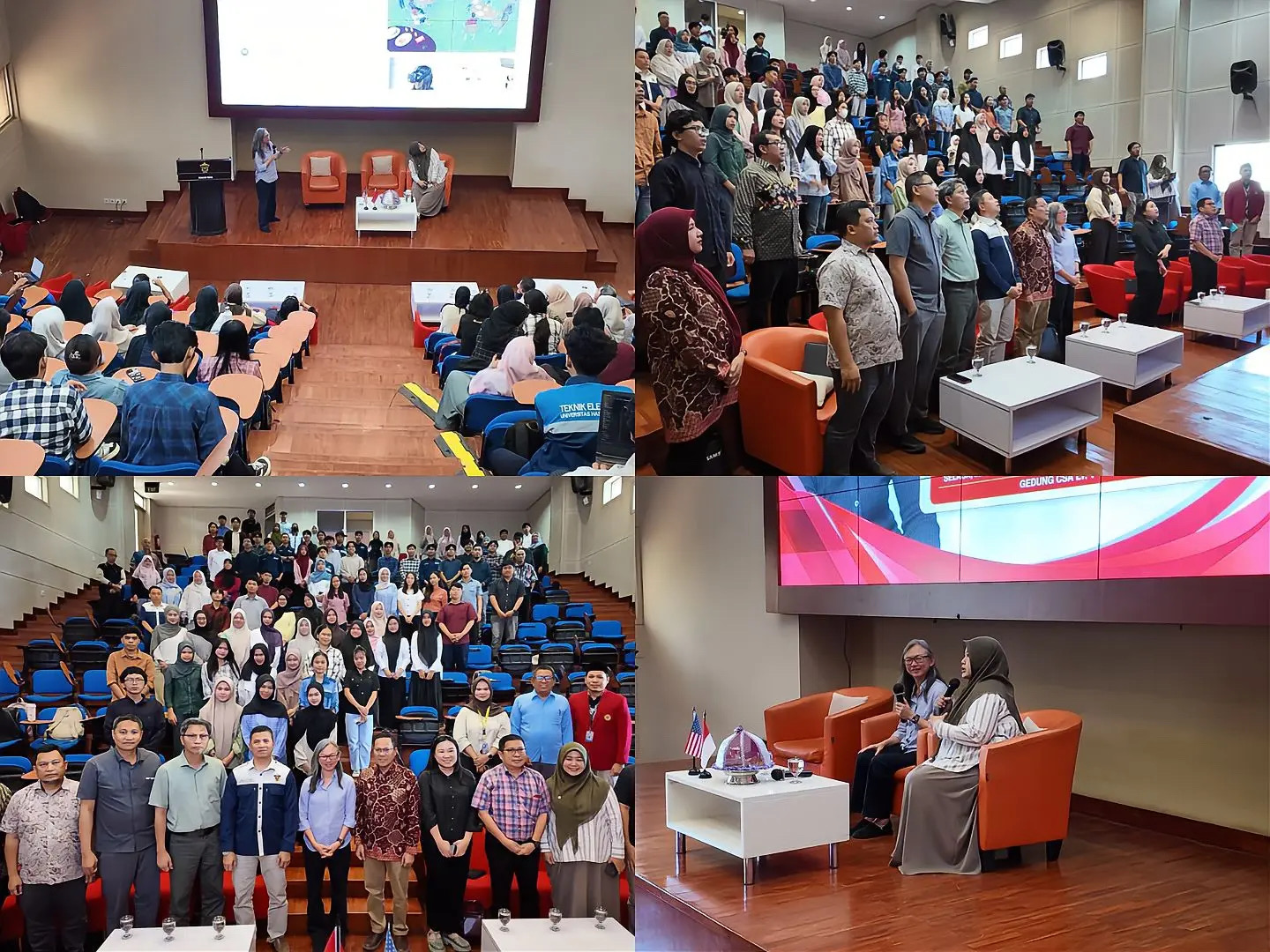
Gowa, 29 September 2026 – The Faculty of Engineering, Hasanuddin University (FT-UH), organized the Diaspora Berdampak event themed “Development of Robotic and Haptic Devices” on Tuesday (29/9). Held at the CSA Building, 1st Floor, Faculty of Engineering UNHAS, the event featured Prof. Sri Kurniawan, Ph.D., Professor of Computational Media at the University of California, Santa Cruz (UCSC), United States, as guest lecturer.
This event served as an academic forum for the Faculty of Engineering community to broaden their knowledge of the latest developments in robotics, haptic devices, Virtual Reality (VR), Artificial Intelligence (AI), and assistive technology. The presence of an international academic also provided a perspective on advancements in research, innovation, and the potential application of these technologies in meeting societal needs.
The event began with remarks from the Dean of the Faculty of Engineering, Prof. Dr. Eng. Ir. Muhammad Isran Ramli, S.T., M.T., IPM., AER. In his remarks, Prof. Isran expressed his appreciation for the presence of Prof. Sri Kurniawan and the opportunity to share knowledge and research experience with the Faculty of Engineering community.
“The presence of Prof. Sri Kurniawan is an excellent opportunity for students and lecturers to gain direct insight into technological developments from an academic who is actively engaged in research at the international level. We hope that events like this can open up discussion, expand academic networks, and encourage opportunities for future collaboration and research development,” said Prof. Isran.
He also emphasized the importance for universities to continuously follow technological advances while directing their utilization towards solving real-world problems. Advancements in robotics, haptic devices, artificial intelligence, and immersive technologies open up greater opportunities for engineering to generate innovations that benefit society, including in healthcare and rehabilitation.
After the opening remarks, the event continued with a material presentation by Prof. Sri Kurniawan. She began her presentation by introducing her research journey and various projects developed through the ASSIST Lab at the University of California, Santa Cruz, particularly in the development of technology oriented towards human needs.
“Technology should not only be developed because we are capable of making it, but also by understanding who will use it and how it can help improve their quality of life,” stated Prof. Sri Kurniawan at the start of her presentation.
Through the ASSIST Lab, Prof. Sri Kurniawan and her team have developed various assistive technologies and human–computer interaction systems designed to meet user needs, including individuals with special needs. This approach places user needs as one of the main considerations in the technology development process.
One of the innovations introduced is the Upper-Extremity eXosuit, a robotic device developed to support rehabilitation of the upper limbs. This device is designed to be flexible, lightweight, and portable, so that it can provide support for user movement during the rehabilitation process.
In addition to robotic technology, Prof. Sri Kurniawan presented the use of Virtual Reality in supporting rehabilitation processes, such as through Project Star Catcher, which adapts therapeutic movement activities into a game-based virtual environment. This approach encourages users to involve weaker limbs in various rehabilitation activities in a more interactive manner.
Immersive technology is also being developed to support social and emotional aspects. Through projects such as EmotionVR and Journey to Recognition, VR technology is used to create learning environments that allow users to practice recognizing emotions and understanding various social situations. This development demonstrates that interactive technology can be used not only for physical rehabilitation, but also holds potential to support learning processes and the development of social skills.
In her presentation, Prof. Sri Kurniawan also explained the integration of various technologies, from Artificial Intelligence, machine learning, sensors, wearable technology, cloud computing, to extended reality. This integration enables the development of systems that are more adaptive to user needs, including in studying interaction patterns, providing feedback, and tailoring experiences based on user characteristics.
Participants were also introduced to a range of facilities and devices used in research at the ASSIST Lab, such as CAVE, motion capture, extended reality technology, wearable and sensing devices, custom hardware, as well as various game engines and programming languages. These diverse facilities support a multidisciplinary approach in the development of interactive systems and assistive technology.
Beyond the technological aspects, Prof. Sri Kurniawan highlighted the importance of collaboration in the development process of assistive technology. Research in this field not only involves academics and researchers, but also requires the involvement of users, communities, health institutions, and industry partners to ensure that the technologies developed address real needs in society.
The event then continued with a discussion and Q&A session with participants. This session served as an interactive forum for students and lecturers to deepen their understanding of robotics, haptic devices, VR, AI, and assistive technology, while also discussing various opportunities for development and application in research and education activities.
Through the organization of Diaspora Berdampak, the Faculty of Engineering continues to strengthen knowledge exchange and academic networking with international academics and institutions. The presence of Prof. Sri Kurniawan from the University of California, Santa Cruz provides an opportunity for the Faculty of Engineering community to gain direct perspectives on the development of interactive and assistive technology research and its application in supporting human needs.
This Diaspora Berdampak event is expected to strengthen the academic culture, collaboration, and innovation within the Faculty of Engineering, while encouraging students and lecturers to develop research that links advances in science and technology with the real needs of society.