
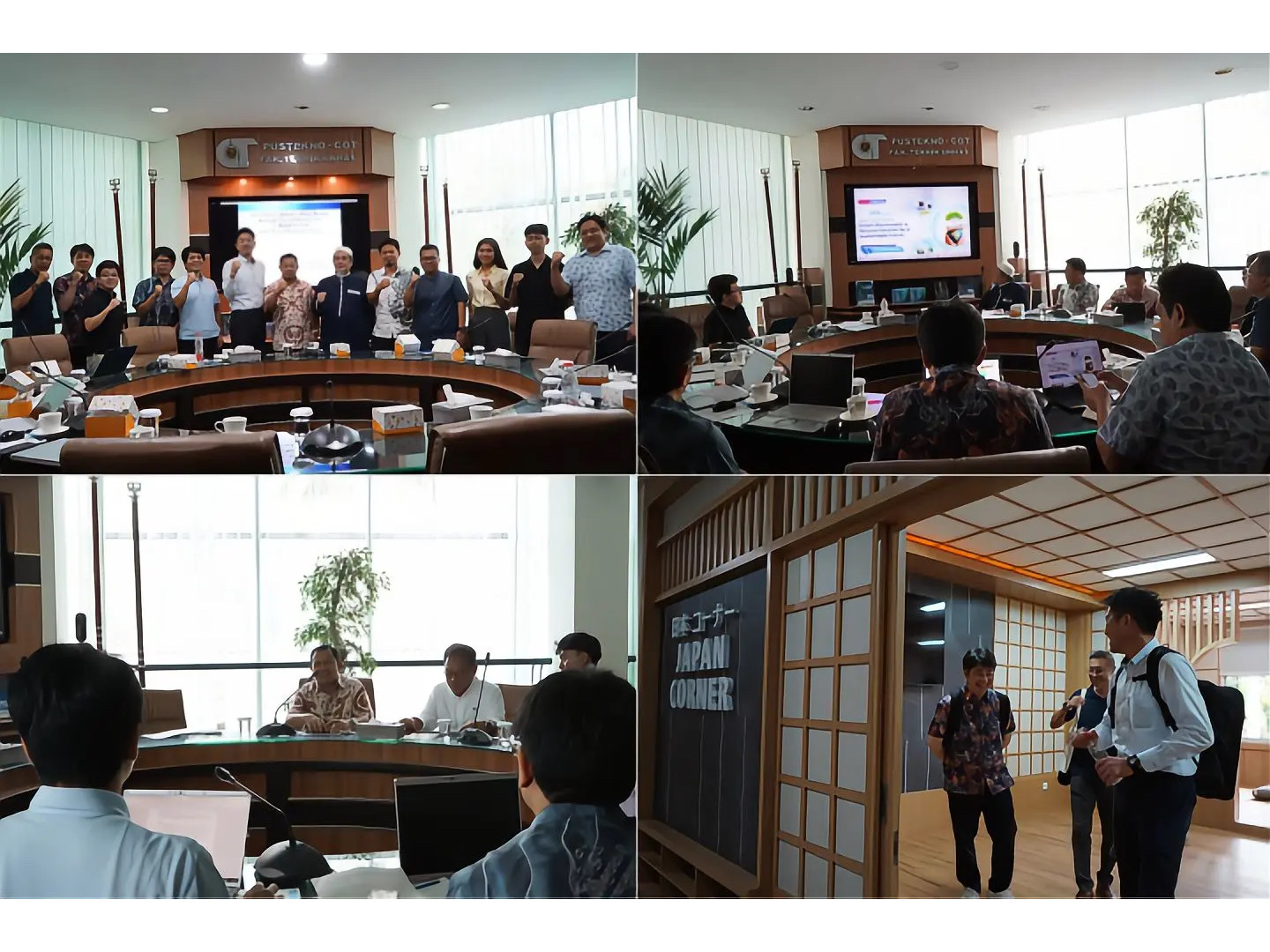
The Faculty of Engineering at Hasanuddin University (FT-UH) is delivering academic solutions with tangible impact for sustainable development. Located at the Center of Technology (CoT) Building, Faculty of Engineering, Hasanuddin University on July 28, 2026, FT-UH welcomed a high-level delegation from Japan to explore a strategic partnership on the City to City Collaboration Project between Kawasaki City and Makassar City for Decarbonization in the Water Infrastructure Sector.
The Japanese delegation was led directly by Hideaki NISHIMOTO, Director of Mikuniya Corporation, accompanied by representatives from Kawasaki City, CTI Engineering International Co., Ltd., and PT Daiki Axis Indonesia. The group was officially received by the Head of the Center of Technology (Kapus Pustekno) CoT FT-UH, Dr.Eng. Faizal, S.T., M.Inf.Tech., M.Eng., alongside the Head of the Civil Engineering Department FT-UH, Prof. Dr. Ir. Muhammad Wihardi Tjaronge, S.T., M.Eng., and the Secretary of the Civil Engineering Department FT-UH, Dr.Eng. Ir. Bambang Bakri, S.T., M.T., IPU., AER.
Strengthening Historic Networks and the Strategic Role of CoT FT-UH
In his opening remarks, Kapus Pustekno CoT FT-UH, Dr.Eng. Faizal, expressed his pleasure over the visit of the Kawasaki City consortium and Japanese industry. He emphasized that the FT-UH campus has strong emotional ties and a long history with Japan through JICA (Japan International Cooperation Agency) funding and the continued C-BEST Project program.
“The Faculty of Engineering at Unhas is always happy to welcome partners from Japan, as the FT-UH campus was built through collaboration with Japan via JICA and the C-BEST Project. The CoT serves as an interface between FT-UH experts, industry (state-owned and private enterprises), and the government. We hope for even closer cooperation between Kawasaki City and CoT,” stated Dr.Eng. Faizal.
Technology Innovation and Business Opportunities Based on Decarbonization
The head of the delegation, Hideaki NISHIMOTO from Mikuniya Corporation, outlined the consortium’s main focus on energy efficiency and decarbonization of water infrastructure and waste treatment. He presented Japan’s experience in managing the Free Nutritious Meal (MBG) scheme, where food waste is processed using advanced methods into eco-friendly compost.
“In Japan, we also have MBG; the leftovers from MBG are processed into compost. Such research has already been implemented in various locations. We are very interested in transforming waste from industrial companies into energy, and this business model can be discussed further. Our focus is on decarbonization,” explained Hideaki NISHIMOTO.
Similarly, Vice Director of PT Daiki Axis Indonesia, Jun ITO, introduced the decentralized wastewater treatment system technology (Johkasou) produced in Cikande, Serang, Banten, built to Japanese quality standards and exported to several Asian and African countries.
“Daiki Axis offers various regular Johkasou models specifically designed for efficient industrial wastewater treatment in Indonesia. These models are equipped to handle high loads, ensuring rapid treatment with minimal maintenance. In addition, we offer Domestic Johkasou models designed specifically for domestic wastewater treatment in Indonesia, addressing the need for effective wastewater management. This domestic wastewater originates from household activities such as cooking, bathing, washing, and handwashing,” explained Jun ITO.
Roadmap for Feasibility Study, JCM Scheme, and Appointment of FT-UH Advisors
The meeting continued with technical presentations regarding the City-to-City Collaboration cooperation document. Water sector Professional Engineer from Kawasaki City, MATSUNAGA Takahiro, delivered a field assessment of water treatment plant installations in Makassar. Annual water distribution at IPA Antang was considered to be still unstable, making it less suitable as a pilot area as it functions only as a backup.
“We recommend IPA Panaikang or IPA Maccini Sombala, which are excellent because they source water from the Bili-Bili Dam. We will submit a proposal to the Makassar City Government, so we request advisory assistance from Unhas. The draft Letter of Agreement will be sent soon,” said MATSUNAGA Takahiro.
According to the project planning documents, this feasibility study sets a decarbonization target through 2029 to support Indonesia’s commitment toward Carbon Neutrality 2050. Several project focuses include:
- Greenhouse Gas Emission Reduction Study under the JCM (Joint Crediting Mechanism) Scheme: Application of the Japanese sludge reduction system to curb methane emissions at the landfill and improve fossil fuel efficiency via subsidies from the Japanese Government.
- Operational Energy Efficiency of Water Treatment Plants: Optimization of pump operations based on water demand forecasting, and the utilization of solar panels and battery storage.
- Non-JCM Studies: Reuse of treated sludge as compost (resource recovery), adoption of Johkasou sanitation, and reduction of water losses (Non-Revenue Water/NRW reduction).
- Policy Collaboration: Preparation of policy and institutional inputs for decentralized wastewater treatment systems.
FT-UH Response: Real Academic Solutions for a Sustainable City
Secretary of the Civil Engineering Department FT-UH, Dr.Eng. Ir. Bambang Bakri, S.T., M.T., IPU., AER., emphasized FT-UH’s readiness to support research and policy implementation in this effort.
“We can carry out joint projects/studies for Makassar City or Kawasaki City, offering extensive expertise from the FT-UH side. Generally, Indonesian government institutions have greater confidence when accompanied by universities. In Makassar City, wastewater treatment has already prepared robust treatment systems, so if there are examples of good water or waste treatment technologies, they can first be introduced to the city government. Also, as of August 2026, Makassar City’s organic and non-organic waste will have been separated,” stressed Dr.Eng. Bambang Bakri.
Through this international collaboration, the Faculty of Engineering at Hasanuddin University continues to strengthen its role as a pillar of innovation and applied research supporting sustainable development, environmental management, and the reinforcement of academic and industry networks at the global level.